Can a small brand get enterprise shipping rates without enterprise volume?
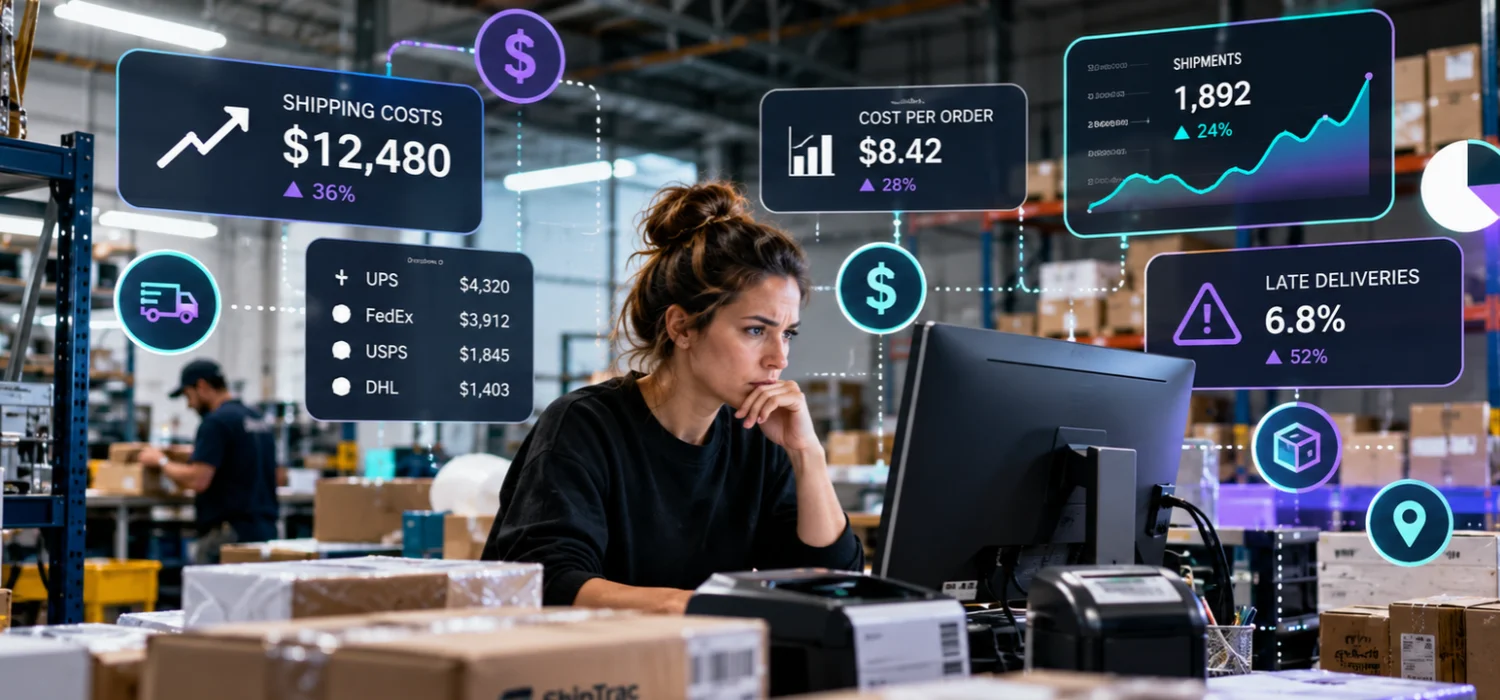
In short—yes! Carriers price on volume and density, not on who signs the contract, so a small brand shipping through a pool of shippers can reach rates it couldn't negotiate alone. How much that saves depends on your carrier mix, package weights and zones. ShipTrac's package-level data analysis can reveal savings of up to 30% when you optimize carrier mix and take advantage of our collective volume.
Key takeaways
- Carriers price on volume and density, so pooled shippers can earn rates one brand can't.
- Your savings depend on carrier mix, package weights and zones.
- ShipTrac delivers savings of up to 30% with a quick, free package-level data analysis.
Why a small shipper pays near list price
Carrier discounts follow a simple logic. A truck stopping at one dock and loading 4,000 parcels costs less per parcel than a van stopping at 40 doors for 100 parcels each. Carriers also like volume they can forecast, because it lets them staff sortation and plan capacity. A brand shipping a few hundred or even a few thousand parcels a week has neither density nor leverage, so it sits close to published rates.
Then the surcharges arrive. Dimensional weight, residential delivery and fuel can claw back much of a headline discount. Anyone who has negotiated a carrier contract knows the discount percentage matters less than what it applies to. That's why "enterprise shipping rates for a small business" is a real thing to want, and also why so many offers under that name disappoint.
What pooled volume changes
Collective volume means many shippers' packages are presented to carriers as one body of volume. The carrier sees the density and predictability of the whole pool. The rates that result are ones no single member could have earned alone. That's the mechanism behind ShipTrac's enterprise-level rates.
Three things sit on top of it:
- Carrier fit by lane. The cheapest carrier for a 1 lb parcel going two zones isn't the cheapest for a 6 lb parcel going across the country. Regional and newer carriers, including Amazon Shipping and UniUni, can win specific lanes and weights. ShipTrac integrates with 20+ carriers, so the mix can be built around your packages instead of one default.
- Dense pickups. Pickups that bundle packages from many shippers cost the carrier less to run than scattered ones. Whether that helps you depends on where you ship from and which carriers serve that origin.
- Ongoing review. A good mix in January can be a mediocre one by summer, as rates and your own order profile shift. Our team keeps looking at it with you.
Read that number for what it is: one lane, one weight band, one origin. It shows the mechanism working on a specific route. It isn't a promise for your freight. A brand shipping 12 lb furniture accessories from Georgia will see a different picture, which is why we start with your data and not with a rate card.
Why the broker pitch usually falls apart
The standard broker pitch is "we have big-shipper discounts, you get a piece." It fails in predictable places. Most of them are checkable before you sign anything.
| What you hear | What to ask | Why it matters |
|---|---|---|
| Up to X% off | Off what, and on which services and weights? | A discount off an inflated base isn't a discount. |
| Better rates than UPS or FedEx | Compared with your actual invoices? | Only your own package data answers this. |
| One carrier, one contract | Who is the right carrier for each lane? | A single carrier rarely wins every weight and zone. |
| No surprises | How are surcharges and adjustments handled? | Invoices drift from quotes without anyone watching. |
Costly mistake
Don't compare quotes to rate cards
Compare them to your last few months of paid invoices, package by package. A rate card tells you what a carrier could charge. Your invoices show what you actually paid after dimensional weight, residential fees and adjustments.
Where it doesn't hold
We'd rather say this now than have you find it later.
- Heavy, long-zone freight. If most of your parcels are heavy and ship coast to coast, the room to improve is narrower, and the carriers that win on light parcels may not win for you.
- Service-sensitive products. Lower-cost carriers can mean tradeoffs in transit speed or tracking detail. For a perishable or high-value product, the cheapest label may be the wrong one. The pitch is the right mix, not the cheapest label.
- Very thin or erratic volume. Pooling helps, but if you ship a handful of parcels a month, the gains are small whatever anyone promises.
- Packaging problems. If dimensional weight is your real cost driver, a better rate on an oversized box only softens the problem. Fixing the box can be worth more.
So the honest answer to "how much will I save?" is that it depends on your carrier mix, your weight bands and your zones.
How to tell whether it applies to you
Pull your package-level data (PLD) for the last three to six months. You want carrier, service, weight, dimensions, origin, destination zone and the final billed amount including surcharges. Then look at three things:
- What share of your parcels are under 2 or 3 lbs? Light parcels are where newer and regional carriers tend to compete hardest.
- What share of your spend is surcharges and adjustments rather than base rate?
- How concentrated is your volume on one carrier? Heavy concentration usually means you're paying list-adjacent rates on lanes where a different carrier would do better.
Shortcut
Start with the free benchmark
ShipTrac's free Shipping Benchmark Tool gives you a first read before you commit to anything. If the gap looks real, the free PLD analysis puts a number on it for your own lanes.
What to do about it
Don't start by switching carriers. Start by knowing what you ship. Run the benchmark, then ask for the PLD analysis if the gap looks worth chasing. You'll see where pooled rates would help, where they wouldn't, and what the tradeoffs are. If the honest answer is that your freight is already well priced, we'll tell you.
See what the right carrier mix could save you
Bring your package-level data and we'll show you where pooled volume helps, where it doesn't, and what service tradeoffs come with it. It's free, and you'll talk to people who've negotiated with carriers.
Try the free Shipping Benchmark ToolFrequently asked questions
Can a small business really get enterprise shipping rates?
Often a meaningful part of them, yes. Carriers price on volume and density, so shipping through a pool of shippers can earn rates a single small account couldn't negotiate. The result depends on your carrier mix, package weights and zones. ShipTrac package-level data analysis can reveal savings of up to 30%.
How is this different from a typical shipping broker?
The truth lies in whether the brokers' claim holds up against your own invoices. A broker may quote a discount off a base you can't verify. Ask what the discount applies to, how surcharges are handled, and whether someone reconciles billed amounts against quoted rates. If those answers are vague, the offer probably is too. ShipTrac doesn't just give you a basic rate card—we analyze your shipping performance and cost and recommend the ideal solutions (carrier mix, locations and rate options) for you.
Do lower-cost carriers mean worse delivery?
Not always, but they can come with tradeoffs in transit speed or tracking detail, depending on the carrier and lane. That's why the goal is the right mix, not the cheapest label. A light, low-value parcel can go on one carrier while a time-sensitive or high-value one stays on another.
What data do I need to find out what I'd save?
Package-level data from the last three to six months: carrier, service, weight, dimensions, origin, destination zone and the final billed amount including surcharges. Carrier invoice exports usually have most of it. With that, an analysis can show which lanes and weight bands have room to improve and which don't.
How do I know I'm billed the rate I was quoted?
Compare what was quoted or paid at label purchase with the final carrier invoice, tracking number by tracking number. Adjustments and surcharges can change the amount after the fact. For 3PLs, FinTrac automates that comparison daily. Brands can ask their 3PL or carrier rep for the same comparison.